Over the past few weeks I’ve been consolidating some shared Google Workspace accounts into one account and setting up (the excellent) Jelly as our shared inbox tool.
I’d assumed that suspending the old accounts would stop the billing, but when the next bill came in I realised that this wasn’t how it worked. In Google Workspace land, suspended users are charged as standard users.
I read the docs properly (as I obviously should have done from the outset) and realised that the suspended user state is intended as a temporary measure. Presumably this is so an administrator can quickly cut a user out of the system without risking any data loss, with the expectation that a user could be restored later. Through this lens it does make sense that the user would still take up a license and be chargeable, but it’s not a great approach if you want to put an account on ice for a while and would prefer not to pay for the privilege. The other obvious option - archiving the data and deleting the user - takes a good while to do and is a bit risky if it turns out a restore is needed.
It turns out there is a middle ground: Google Workspace has a concept of Archived User accounts. Setting this up involves adding a new Archived User subscription plan to the account, alongside the normal plan. This allows users to (unsurprisingly, I know) be archived, rather than suspended or outright deleted. Archived users are moved onto the Archived User plan, which has a lower per-user cost than a standard account. The exact cost depends on the main plan level. After a retention period, the archived user could be deleted.
I guess this feature is well known to serious Google Workspace administrators, but as a non-expert the standard user actions menu gave me no hint that archiving was an option.
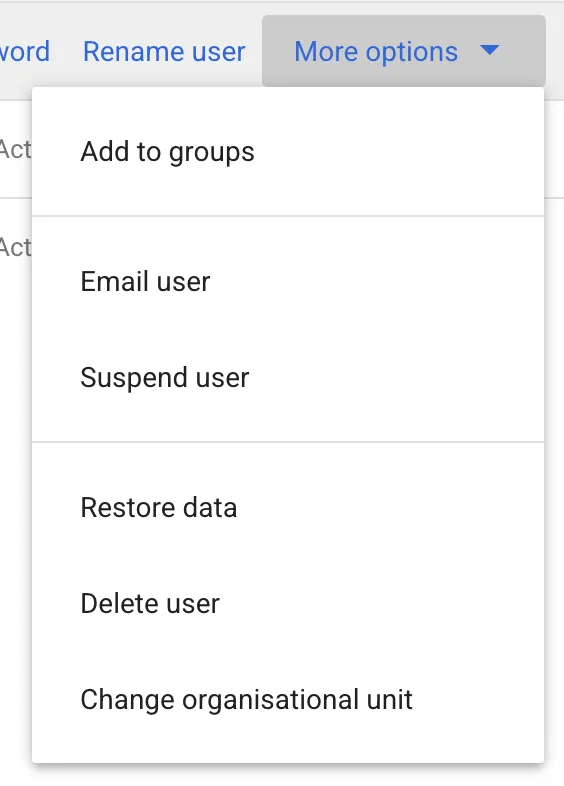
Good to know it’s possible, though.